AI solutions for evolutionary genomics of nonmodel species
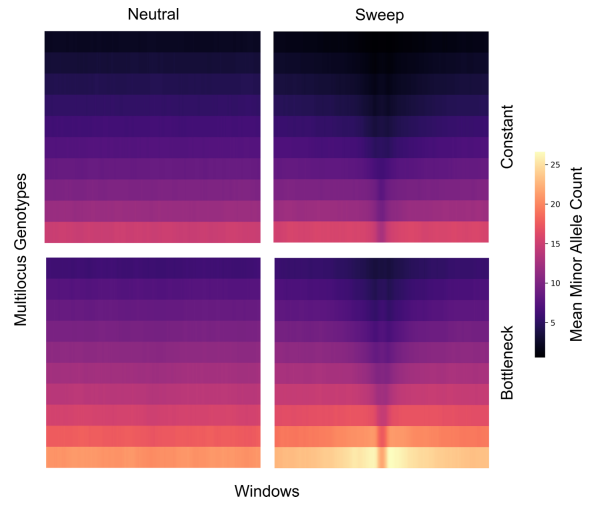
As large-scale genomic datasets are becoming abundant, new questions can now be posed in evolutionary biology. Although innovative methodological approaches are constantly developed to test these new hypotheses, their application to the study of nonmodel species is hampered by technical challenges associated with such systems. In recent years, artificial intelligence (AI) solutions, mostly in the form of deep neural networks, have been successfully introduced to analyse genomic data from nonmodel species. Here, we highlight the latest trends in deep learning to infer demographic history and signals of natural selection, and offer novel research directions to develop AI algorithms for the study of nonmodel organisms. Specifically, we identify strategies to process data missingness and uncertainty, to infer selective events in the face of unknown genomic and demographic parameters, and to generate interpretable and explainable predictions. We demonstrate our arguments by showcasing an original implementation to detect selective sweeps from an experimental setting with low sample size, uncertain sequencing data, and unknown demographic model, as typical in studies of nonmodel species. We argue that the study of nonmodel organisms is an opportunity to develop general-purpose data-driven methodologies for evolutionary inferences. Fair sharing of resources and inclusive frameworks are key to enabling researchers to benefit the most from this new wave of technologies.
The review is available here.